Overlapping swing positions and shared events
Keep common exposure, cash and complete position populations visible instead of treating every row as independent risk.
A position count does not establish independent exposure
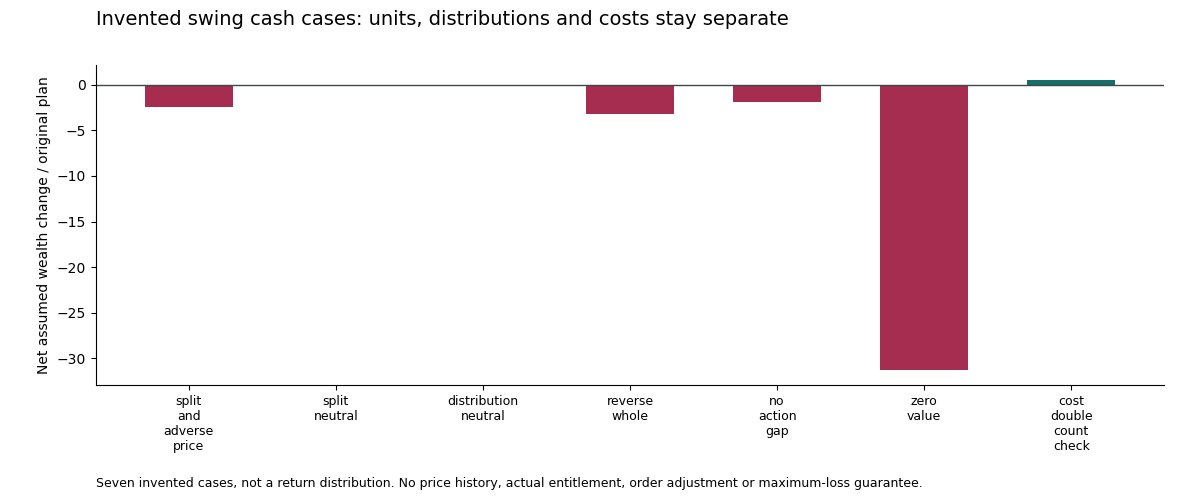
Several long positions can share a sector, event, financing constraint or market move. A collection of planned stops is not automatically a measured portfolio-loss distribution. Preserve actual units, overlapping times, common drivers and account cash before a stronger aggregation. An entry objective can be causally trained while later overlap still affects sizing or acceptance under the selected experiment. The tutorial's seven branches are alternatives, not simultaneous positions. Adding them would manufacture a portfolio with incompatible action assumptions. The new tool evaluates one original position in one cash unit and explicitly provides no probability weights or account-return path.
A fictional shared announcement
Suppose invented positions A and B each have planned loss 100, both exposed to the same event window. Summing plans gives 200 reference units, but says nothing about likelihood, dependence, actual fills or the possible loss beyond those references. If a manual stress gives losses 160 and 240, their conditional sum is 400. It is not a quantified portfolio tail, because the joint scenario and source assumptions still need a contract. These values are original fiction rather than observed positions. A real review must retain event knowledge, executable conditions, financing and exact source versions rather than presenting separate stop distances as proof that each position's risk is independent.
Cash and distributions cannot be spent twice
An actual account needs the timeline of purchases, sales, settlement, distributions and costs. A declared dividend in a fixed-position worksheet is not evidence that funds were available for another trade. The cost is charged once per original quantity in the example; duplicating it or omitting another position's cost changes the source convention. The original gap tool has a separate conservative cash cap and cannot be combined with the fixed 100-share case without an actual quantity path. Preserve position identity and funded cash rather than selecting just favourable completed rows or ignoring overlapping unresolved exposure. Those missing sources are financial-accounting questions, not solved by a larger word count.
Overlap evaluates the frozen experiment without selecting a new entry
The authorised process can use holding drift and overlap to validate, reject or size a frozen candidate. It must not make exit-adjusted payoff the criterion that ranked the original entry, or silently reopen exit selection after evaluation. Keep actual policy identity and the independent master. No such model study is performed by this publication, and no production portfolio controller is added. Actual live routes need managed-cloud state and certification with personal computers off. A source-model summary, graded message or working notebook cannot prove those states. The education instead makes the complete population and shared-event questions more explicit without inventing a tested vendor or safe allocation.
Filled fictional swing case
For fictional A and B,200 summed planned risk and 400 conditional stress loss answer different arithmetic questions. Neither supplies dependence or probability. The two cases are not drawn from the seven-case workbook and cannot be merged with its branches into an observed portfolio. The completed lesson is that common exposure, cash timeline and complete units need their own sources before a financial aggregation or sizing claim is strengthened.
| Object | Record | Bounded finding |
|---|---|---|
| Planned references | 100+100=200 | No joint distribution |
| Entered stress | 160+240=400 | Conditional sum only |
| Workbook branches | Alternative scenarios | Not held together |
Primary references and scope
Expanded source review: 13 October 2026. Documentation supports the stated mechanism, not a tested account, hypothetical fill or provider outcome.