Filled swing corporate-action cash workbook
Seven invented cases. Original units, changed units, gross cash and costs reconciled separately.
One declared action, one original quantity
The packet contains seven invented arithmetic cases, not trades sampled from a market. Every case uses a fixed original long-share quantity, an original entry and planned stop, one split ratio, a manually declared post-action price, gross distribution cash per original share and a round-trip cost per original share. There is no real instrument, account, broker, exchange session or corporate announcement. Quantities and prices are educational inputs. Python Decimal independently produces the expected results, and the browser uses decimal.js 10.6.0. These correctness references do not demonstrate a profitable swing strategy, calibrate a gap probability or substitute for an independent economic master.
The action ratio is new shares divided by old shares. A two-for-one declaration converts 100 original shares into 200 assumed shares. Original entry 100 and stop 97 have split-equivalent reference levels50 and 48.5 respectively. Those converted reference levels are arithmetic only. An actual broker's outstanding orders, restrictions and effective instructions require their own sources; the tool neither adjusts them nor promises they were adjusted. A reverse split is accepted only when the post-action quantity is whole. Fractional shares and cash-in-lieu are explicitly outside the contract rather than rounded into a convenient funded account.
The adverse-price reference is fully reconciled
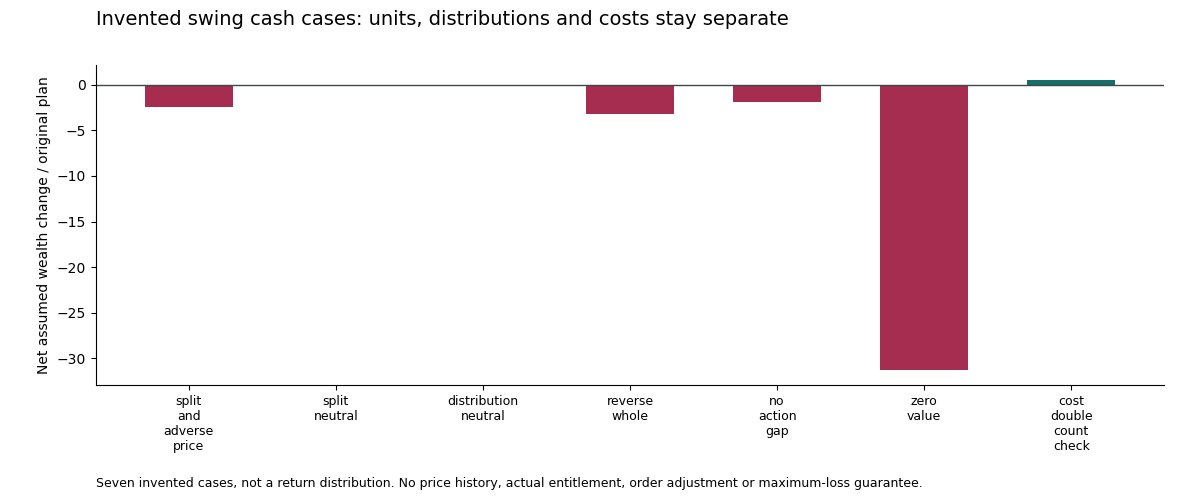
The default has 100 original shares at 100, a planned stop 97, a two-for-one ratio and post-action price 46. Original notional is 10,000. Two hundred assumed shares at 46 give9,200 market value, or-800 price-only change. The declared gross distribution is 0.50 per original share, giving 50 cash. One declared round-trip cost is 0.20 per original share, giving 20 cost. Gross assumed wealth change is -750; net change is -770. Original planned loss, including the same cost once, is 100 times(100-97+0.20), or320. Net change divided by that frozen original plan is -2.40625.
This ratio is an assumed cash comparison, not compounded return, a maximum loss or a measured gap frequency. The post-action price is entered manually rather than generated from a market path. Gross distribution eligibility, withholding, payment, cash availability and taxes are not established. The cost input is a complete declared round-trip total on the original quantity; it must not be charged again elsewhere. A real statement would need actual event notices, entitlements, executions, fees and account cash. The educational reconciliation can be complete while all of those real sources remain absent.
A split and a distribution answer different questions
The split-neutral case turns100 shares at 100 into 200 assumed shares at 50, with no distribution or costs. Market value stays10,000 and wealth change is zero. A split ratio changes units and equivalent prices; it does not create a measured gain by itself in this invented example. The separate distribution-neutral case has no split: price 99 and declared gross cash 1 per original share offset a 100 entry before costs. That arithmetic does not forecast an actual ex-date price response or verify eligibility. Keeping the two cases separate avoids treating every lower chart price as an economic loss or every dividend announcement as spendable cash.
The reverse-whole case uses50 assumed shares at 180 from 100 original shares at 100 under a one-for-two ratio. Its price-only change is -1,000 and net after20 cost is -1,020. A zero-price scenario is also preserved; it is not excluded because it looks severe. The positive-price/cash case subtracts the one round-trip cost once. These deliberately different branches expose the accounting choices without representing a fitted model or empirical distribution. All seven cases remain in the downloadable CSV and JSON, with no selected winning subset and no financial probability attached to the graph.
Original risk is not the broker stop owner
The original planned-loss denominator remains based on the original quantity, entry, stop and declared cost. A later split-equivalent reference or entered post-action price does not silently replace it. A reader comparing completed positions should preserve the chosen denominator and complete quantity path rather than normalising every result to a more flattering new risk number. Actual stop adjustment and execution remain operational sources. A stop trigger is not a fixed-price execution promise. The original gap-stress worksheet remains alongside this fixed-quantity cash lens, with its separate cash cap and rounded-down quantity contract.
The publication does not add a daily stop manager, profit floor, bracket controller or account closing service. Native minute-execution, whole-position exit, maximum-hold ownership and the canonical best hypothetical research fill convention are unchanged. The examples are not an actual instrument route or strategy-validation task. A real research study still needs its authorised factory, causal entry objective, frozen entry identity, one predeclared exit, complete selection history and independent master. A finished local arithmetic test does not promote a model, grant execution permission or certify a subscriber route.
Downloads keep the assumptions visible
The filled CSV names every case, all original inputs, all independently calculated results and the invented classification. The JSON retains null probabilities and null actual fills. A separate source record identifies the pinned decimal dependency and exact library hash. The supplied dependency licence accompanies the public code, without granting rights over actual market history, proprietary models or third-party documents. The original blank review records and long swing protocols remain available. A reader can compare the exact scenarios, load one into the cash lens, edit assumptions and export the resulting local working record.
Browser controls accept bounded plain decimal fields and whole quantities/ratios under a stated contract. Blank, negative, nonfinite, out-of-range or unsupported fractional-result inputs clear output and disable export. Reload and reset keep no stored drafts. There is no account credential, arbitrary market-feed URL, input upload or production scheduler. The tool is available as a managed-cloud static publication with personal computers off. Deeper visible lessons, consistent metadata, full-text search and machine mirrors support discovery, but none guarantees search rank, an AI citation, suitability or marketing ROI.
Complete invented reference cases
| Case | Post shares | Price-only change | Gross declared cash | Declared cost | Net change |
|---|---|---|---|---|---|
| Two-for-one plus adverse price | 200.0 | -800.0 | 50.0 | 20.0 | -770.0 |
| Split-only unit neutrality | 200.0 | 0.0 | 0.0 | 0.0 | 0.0 |
| Price and gross cash together | 100.0 | -100.0 | 100.0 | 0.0 | 0.0 |
| Whole-quantity reverse split | 50.0 | -1000.0 | 0.0 | 20.0 | -1020.0 |
| No action, manually chosen gap | 100.0 | -600.0 | 0.0 | 20.0 | -620.0 |
| Zero-price scenario | 100.0 | -10000.0 | 0.0 | 20.0 | -10020.0 |
| One declared round-trip cost | 100.0 | 100.0 | 100.0 | 20.0 | 180.0 |