Adjusted prices and raw execution references
Freeze the adjustment convention and action factors before combining a chart, stop and actual cash record.
Price normalisation has a declared purpose
A historical series may adjust for splits, distributions or both according to its source. That helps define comparable prices for a chosen task, but it is not necessarily the actual price at which a broker executed an order. Record raw source identity, adjustment mode, factor history and effective availability before combining series. A chart downloaded later can contain retrospectively revised factors. The relevant source convention needs its actual records, not a generic adjusted label. The corporate-action documentation describes modelling choices; the educational cash lens instead takes one manually declared ratio and preserves original quantity. It does not reconstruct a licensed price history or claim an engine's convention is universal.
The split-neutral case separates price from wealth
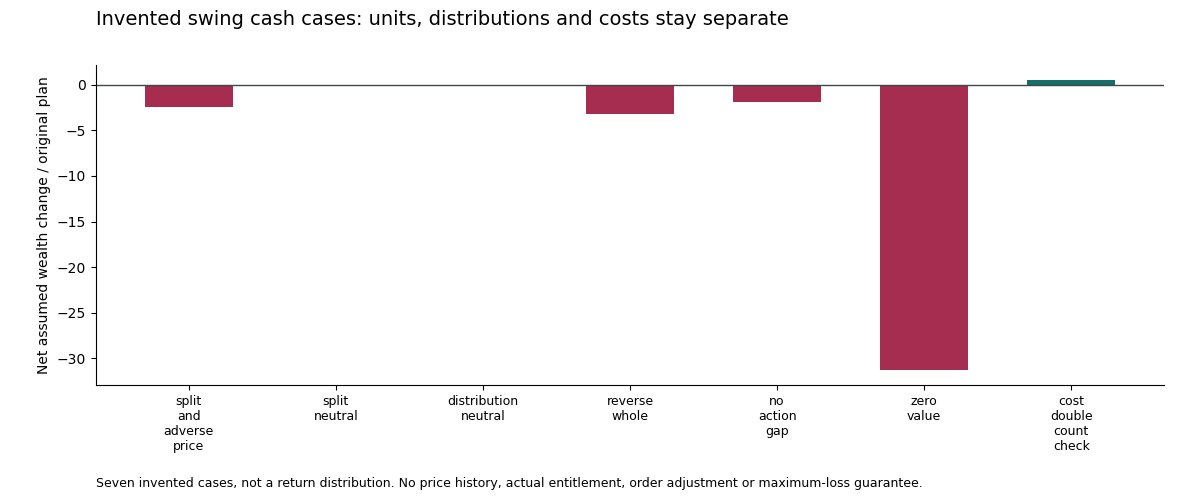
The invented neutral example has100 shares at100 before a two-for-one ratio and200 shares at50 afterwards. Market value remains10,000 with no distributions or cost. Comparing100 directly with50 as though the same units survived would misstate the example's economic change. Likewise comparing a pre-action stop97 with an adjusted post-action chart without a basis conversion can create an apparent breach unrelated to the original rule. The tool exposes48.5 as a split-equivalent reference, not an actual broker stop. Real action timing, orders and executions remain different sources and are not inferred from the numerical equality.
Distributions must not be counted twice
A total-return or distribution-adjusted series may already include a convention for cash benefits. Adding declared distribution cash again can double-count the same object. A raw price and an independently established account cash receipt form a different source path. The workbook's distribution-neutral example explicitly uses price-only movement and separate gross declared cash, with no claim of entitlement or tax treatment. Its inputs are invented and cannot identify a actual source's adjustment method. Preserve what each record includes, the chosen denominator and the quantity path. A correct formula still gives the wrong economic interpretation when its price and cash sources have inconsistent scope.
Original references cannot be rewritten after an outcome
The selected planned-risk denominator and original rule should retain their basis across a later action. Do not choose whichever adjusted or raw level produces a more favourable result after validation. Actual research preserves entry identity, one selected exit and complete data versions; operational order adjustments preserve their separate owner and authoritative state. The publication neither changes those policies nor declares a verified model from its seven cash cases. All original long swing protocols remain alongside the filled references. A complete outside review needs actual history, rights, economic calculation and independent scope rather than a provider screenshot, a plausible action factor or an attractive chart alone.
Filled fictional swing case
In the invented neutral split,10,000 original value equals10,000 post-action value. The apparent half-price move is a unit comparison, not a50% account loss. A second case's distribution is entered separately from price-only change so it cannot be silently counted twice. The completed finding is source-basis reconciliation; no real event, tax, entitlement, broker adjustment or actual market return is established.
| Object | Record | Bounded finding |
|---|---|---|
| Raw original | 100 shares /100 entry | Original quantity basis |
| Split-equivalent | 200 /50 reference | Neutral value example |
| Cash distribution | Separate declared field | No double-count permission |
Primary references and scope
Expanded source review: 13 October 2026. Documentation supports the stated mechanism, not a tested account, hypothetical fill or provider outcome.