A Swing Trading Journal for Scheduled Events and Thesis Changes
Record the original hypothesis, event information, holding assumptions and revisions without turning a later story into an earlier reason for entry.
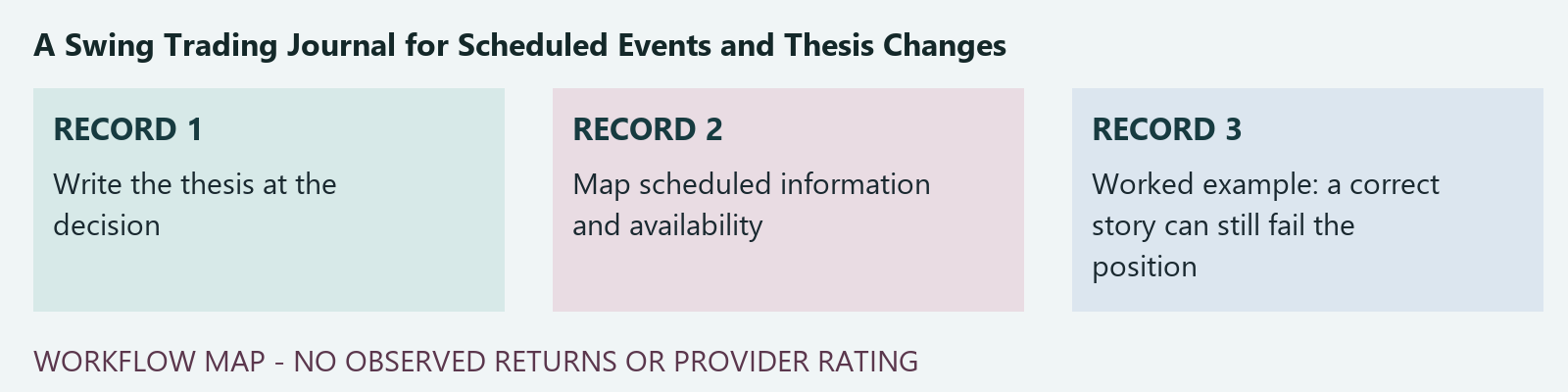
Write the thesis at the decision
Identify instrument, observed setup, intended horizon and what information supports the proposed position. Keep the factual observation separate from the prediction. A price near a prior reference is an observation; expected recovery is a hypothesis. Record what would invalidate it and which events could change the interpretation. Do not rewrite the initial rationale after an outcome so every winning trade looks planned and every loss becomes an unavoidable surprise. The journal should preserve the original uncertainty.
Map scheduled information and availability
Record the event source, expected release window and the version of the schedule used. Earnings, policy decisions and corporate actions need their own actual primary notices; this chapter does not supply a current calendar. Save publication and access times for any new information. A revised release or retrospective summary cannot be assigned to an earlier decision. Identify whether holding through an event was part of the original plan or a later choice, and retain the version which authorised that choice.
Worked example: a correct story can still fail the position
Invent a thesis expecting a company's longer-term margins to improve. An upcoming announcement produces a short-lived price gap adverse to the position even while the later business narrative remains plausible. The journal must separate thesis evaluation from order execution, financing and account suitability. It should not label the position a success merely because the story eventually looks correct, or prove the story false merely because the planned exit failed. This fictional scenario supplies no real earnings prediction or trading recommendation.
Keep every amendment accountable
Record changed target, stop, horizon or exposure with time, reason and information available. An extension after a loss is a new decision, not evidence that the original holding rule always allowed it. Preserve partial fills and remaining quantities under a stable position-family ID. SEC order references explain why intended exits differ from execution; actual broker events are required for the account history. A provider amendment and a subscriber's response can occur at different times and should not be collapsed into one event.
Include open exposure at review
The review window should retain unsettled positions and marked valuations instead of summarising only completed winners. Costs, cash flows, currency and quantity belong beside account outcomes. A raw move on a call is not necessarily a portfolio return. Performance-reporting standards provide conceptual scope, not a compliance claim for this journal. If the account trail is unavailable, classify the entry as a hypothetical or supplied record rather than reconstructing execution from a later chart.
Close with a learning question
At the declared review time, compare original observation, thesis, events and decisions with what actually became known. Ask which rule was ambiguous, what evidence changed the interpretation and whether the journal captured the adverse path. Do not treat a small set of outcomes as proof that a strategy works or that an event filter improves performance. This chapter offers a disciplined record template and invented scenario. Its purpose is to make a swing decision understandable without disguising later knowledge as foresight or erasing the position's economic limits.
Decision record
| Question | Record to retain | Decision boundary |
|---|---|---|
| Original thesis | Observation, prediction and invalidation at entry | Do not reconstruct rationale after the result |
| Event | Primary notice, schedule version and release time | Later revisions are not earlier information |
| Amendment | Changed field, authority and reason | A new holding decision is not the original plan |
| Review | Open exposure and bounded learning conclusion | A plausible narrative does not prove account success |
Blank working record
The worksheet contains column headings only. Enter your own dated observations, keep absent evidence marked unknown, and do not treat the file as certification.
 Download worksheet (CSV)
Primary references
These documents support mechanisms and source definitions, not a tested trading result or a recommendation. Accessed 9 October 2026. The decision workflow and invented examples above are editorial exercises.
Keep reading
Publication methodology | Working glossary | Source and correction policy
Keep calendar revisions beside the thesis
An event date and the time it became available to a decision process are different fields. An actual revision should preserve the old expected date, new date, source identity, acquisition time and effective policy rather than overwriting the original thesis. The new holding-clock and point-in-time guides supply narrow fictional cases, not real company announcements. The original journal worksheet and negative examples remain. A source declaration, received note, acknowledged order and filled position have different authority. Correctly importing the cash packet does not establish any of those operational events or a complete real outcome population.