Overnight orders and session eligibility
Record the selected order and session contract instead of assuming a stop is active whenever a chart moves.
An order needs both type and session scope
A swing position can remain exposed when its selected order is not eligible for a particular session or venue state. Record order type, time-in-force, session settings, transmitted identity and account permissions. A chart price moving outside regular hours does not itself prove that a stop was active or executed. Official order and extended-hours sources explain mechanisms and risks; the actual chosen broker implementation still needs its current documentation and authoritative records. The site does not infer them from a generic platform description. Its manually entered adverse prices remain scenarios rather than independent observations of an overnight order's behaviour.
A fictional closed-market interval
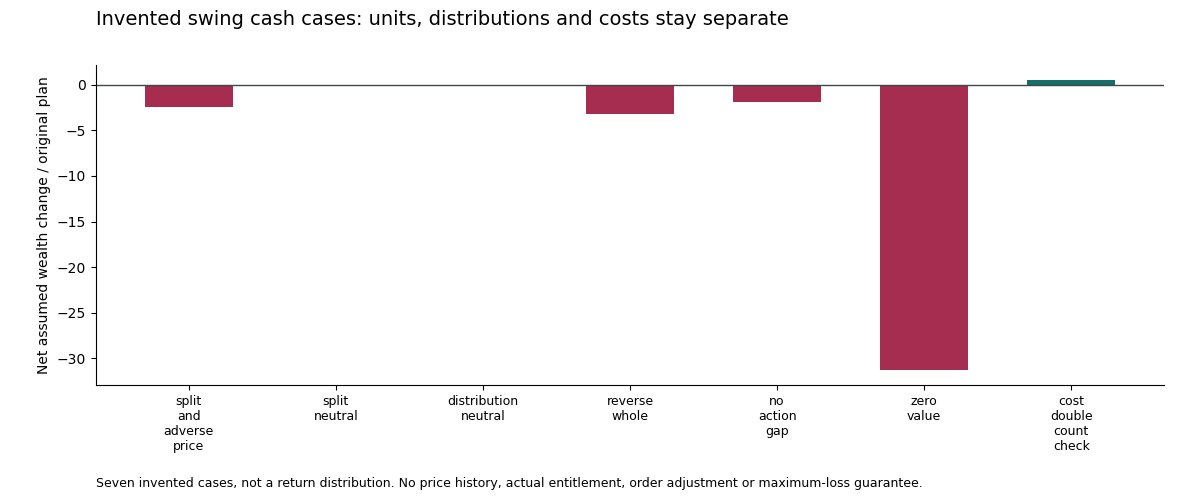
Imagine an invented position with an original stop reference 97 and later selected stress price 94. The worksheet can compute the loss at 94, but cannot decide whether the stop was eligible, which quote activated it or which quantity actually filled. The original 48-share tool reports 292.80 under its chosen cost and cash contract. That is a conditional calculation, not evidence that a broker executed those shares. The new fixed-quantity lens answers a separate accounting question. An actual review should preserve the original order request, acknowledgement, session scope, amendments, cancellations, executions and costs rather than choosing the most reassuring interpretation of a later chart.
Reference, trigger and fill are not the same object
The planned stop establishes a chosen reference distance in the tutorial. A trigger event and execution have different operational evidence. A stop can lead to a market-order execution price that differs from its trigger; a limit introduces a price condition without guaranteeing a fill. Those mechanism statements do not determine what happened to a selected account. Corporate actions can also change units and order treatment, so a calculated split-equivalent stop is not an automatic transmission receipt. Keep actual order and action sources with their effective times before calculating funded performance or asserting that a policy protected a position throughout every overnight interval.
The publication does not take production exit ownership
No broker connection, bracket controller, daily manager, tunnel or personal-computer fallback is added. Real APEX analysis uses its verified minute execution and persisted ownership, with native risk and maximum-hold rules preserved. A completed-session routine can count holding periods without setting daily stop floors. The canonical hypothetical research fill convention also stays separate from actual executions. The original long protocols and source references remain alongside the filled cash cases. Software correctness, a current documentation link and a polished scenario cannot replace operational certification, an independent economic master or the receiving-account record required for a stronger claim.
Filled fictional swing case
At the invented 94 price, the original gap tool reconciles 292.80 on 48 shares, but actual stop eligibility and fill state remain open. An after-hours chart and a standing stop reference answer different questions. The completed finding is a loss conditional on selected price and costs, not a maximum loss, measured overnight execution or proof that every session was protected. No actual ticker, broker or market interval is represented.
| Object | Record | Bounded finding |
|---|---|---|
| Stop reference | 97 invented | Risk-plan input |
| Stress price | 94 chosen | No probability |
| Order eligibility | No source | Operational question open |
Primary references and scope
Expanded source review: 13 October 2026. Documentation supports the stated mechanism, not a tested account, hypothetical fill or provider outcome.