Trading interruptions, reopening and swing liquidity
Keep a valuation observation separate from an executable reopening price and actual order state.
A tradable state needs its own source
A price observation, a market status and an executable order are different objects. A swing position can remain economically exposed when a selected venue is interrupted or liquidity changes. A current chart alone does not establish order eligibility, queue state, reopening conditions or available quantity. Use the actual exchange, broker and security records for the chosen event. The website adds no universal halt rule or real interruption calendar. Official order and session sources help name the mechanism, while selected operational behaviour remains another evidence task. A manually entered adverse price cannot authenticate a reopening or promise that a receiver could execute at that level.
A fictional reopening scenario remains conditional
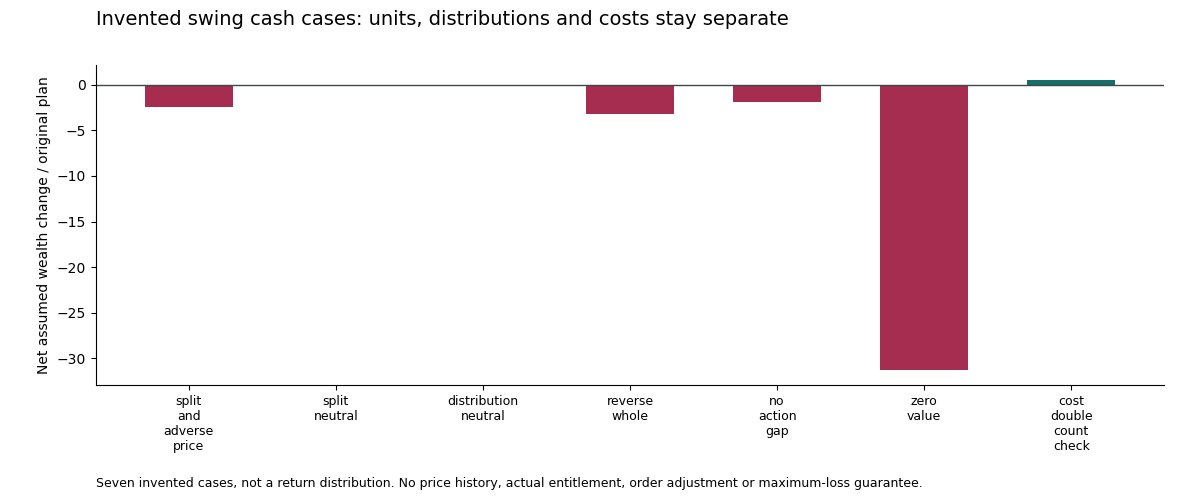
Suppose an invented account-like example has entry 100, planned stop 97 and later declared valuation 80. A fixed 100-share long position without action or distribution, with cost 0.2 per original share, has net assumed change -2,020 and original planned loss 320. That arithmetic does not describe a real reopening auction, liquidity, fill or account. It simply shows that a chosen valuation can exceed the planned distance. The actual exit can differ again, and a cash figure can be marked to a price without being realised. Keep declared valuation, actual executions, quantity and fees separate before presenting a stress case as funded financial performance.
Do not replace a missing path with its endpoints
A before-and-after chart lacks the intervening tradeability and actual order events unless its sources provide them. Pending, cancelled, rejected and filled instructions may have different outcomes. An actual review needs authoritative requests, acknowledgements, amendments, execution quantities and effective risk owner. A daily bar cannot identify every intrabar path, and retrospective action factors may alter displayed levels. The original swing gap guide and new adjusted-price lesson preserve these distinctions. The cash lens computes endpoints only, so it cannot decide event sequence or replace the canonical hypothetical fill window with whichever later price makes the result favourable.
Incomplete execution evidence is not a model verdict
Missing actual order records leave an operational question unresolved. They do not prove that a particular instrument has failed the complete research factory or that a named vendor committed fraud. A real instrument task must retain its data route, raw entry objective, frozen identity, one selected exit and independently verified master. This publication performs no such task and changes no live stop owner. Its zero-price scenario is retained as an extreme assumed branch, not a quantified likelihood or maximum-loss certificate. The site invents no user population, external audit or execution guarantee to make an adverse example look independently established.
Filled fictional swing case
At invented 80, the fixed 100-share calculation gives -2,020 after 20 declared cost and -6.3125 relative to 320 original plan. Actual execution remains null. The completed finding is conditional endpoint arithmetic with absent liquidity and order sources, not a real interruption or a claimed worst possible outcome. No ticker, exchange incident, broker, price history or funded account is represented by these numbers.
| Object | Record | Bounded finding |
|---|---|---|
| Valuation 80 | Manual assumption | Not a fill |
| Net -2,020 | 100 original shares | Declared cost once |
| Order journal | Not supplied | Sequence unresolved |
Primary references and scope
Expanded source review: 13 October 2026. Documentation supports the stated mechanism, not a tested account, hypothetical fill or provider outcome.